Part Two: Musical MacGyvers
Isolation naturally creates scarcity of materials, equipment, and information and with that comes a need to improvise with and adapt what is available. This does not only refer to equipment, but the music itself.
In speaking with musicians from different generations, one theme appeared again and again: an attitude of musical adaption and resourcefulness. This does not only apply to the gear, but also the music itself.
Tea-Chest instruments.
Vincent speaks about tea-chest basses, which he believes may have been inspired by similar instruments from Africa: a pole attached to a wooden box with a string stretched across it, the tension adjusted to change pitch. Tony recalls homemade guitars, DIY radios, and modifying his own studio equipment. Stewie’s first drum kit was made from buckets and spoons. Saints were not always able to get the instruments and tools they needed to imitate the records they heard. Instead, the adapted the tools at their disposal to make a local rendering of it.
Another man’s trash.
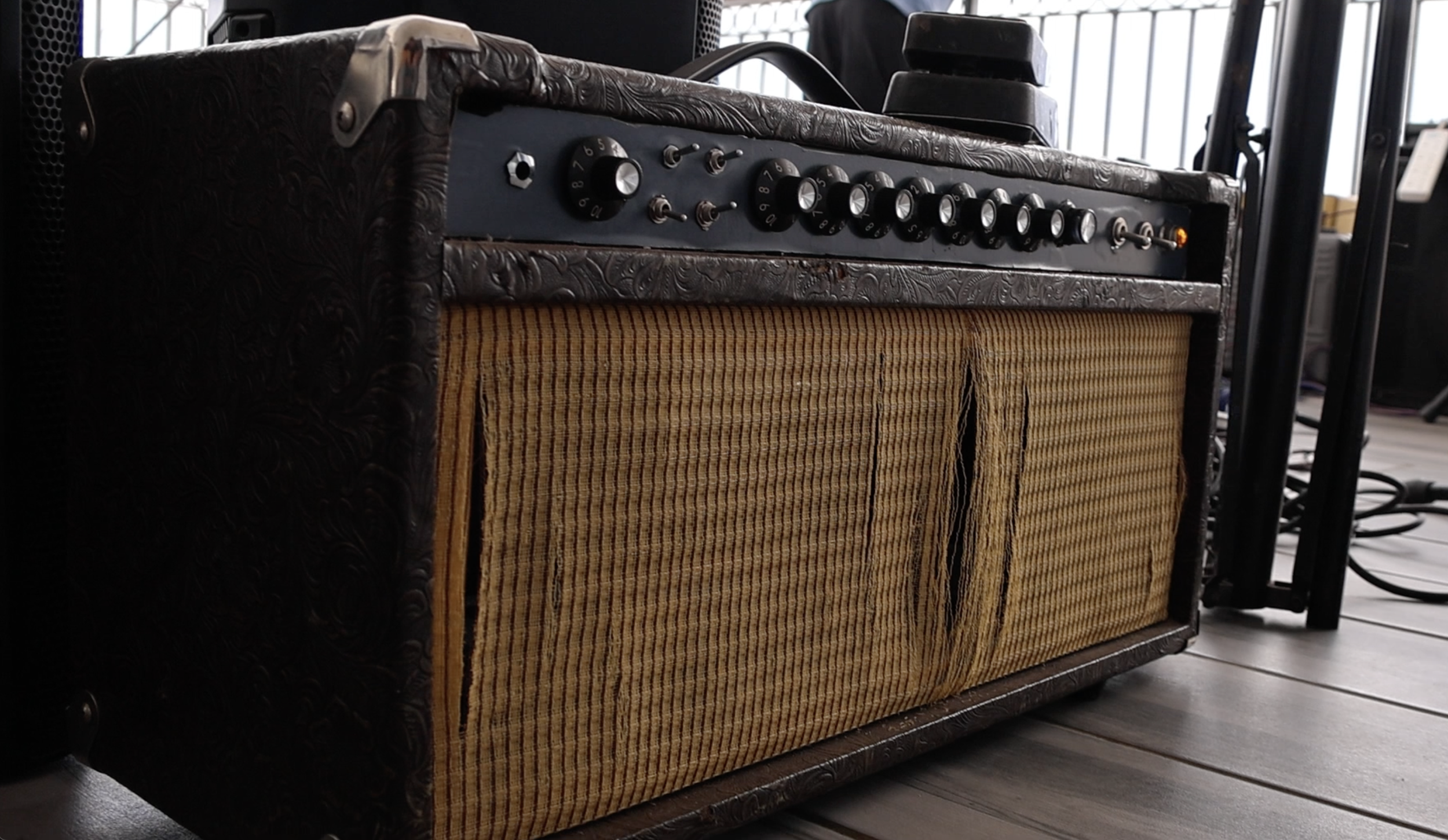
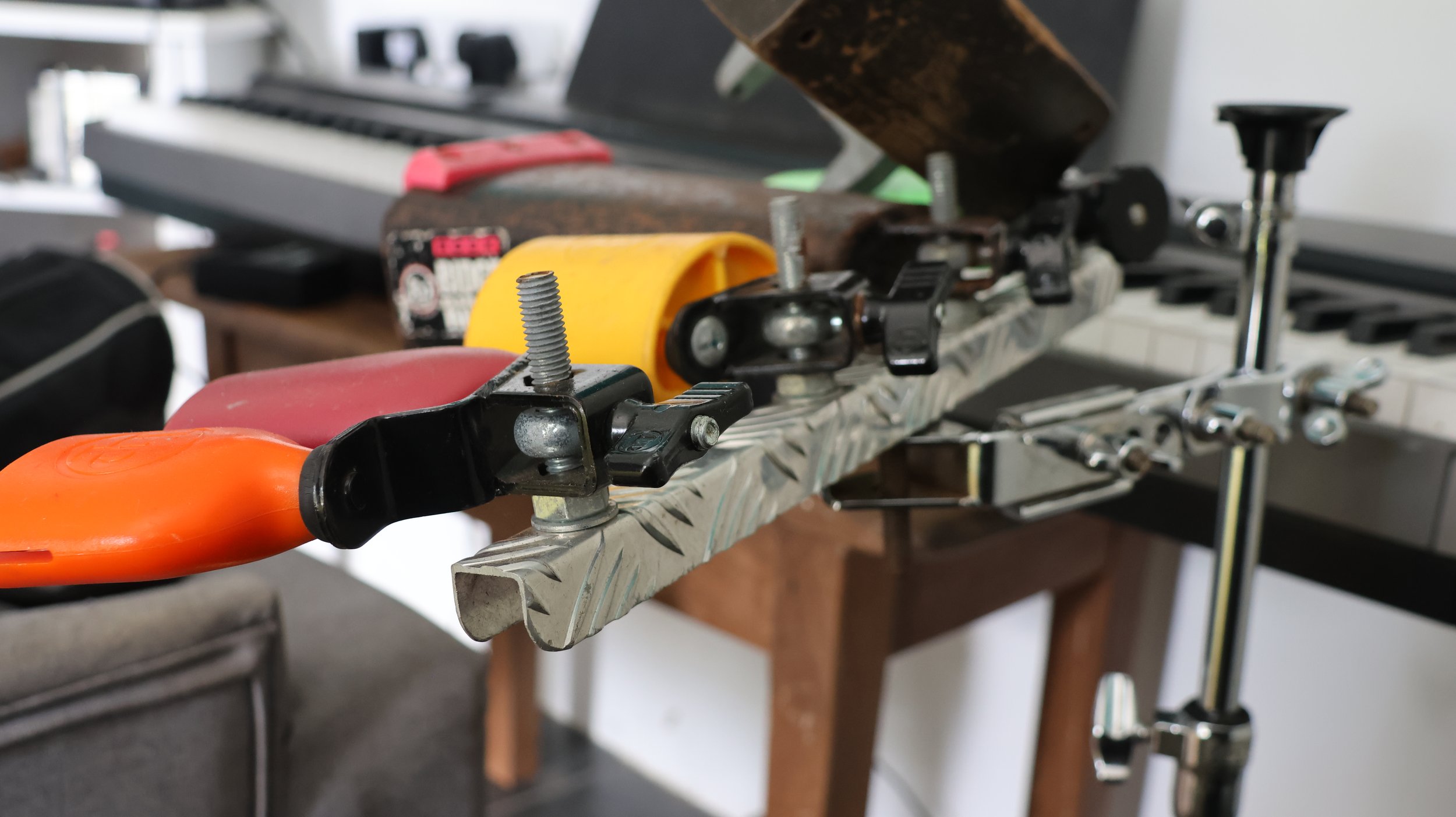
People do not like to throw things away on the island. Most things are imported at great cost, and not easily replaced. A common activity for many is to visit the local landfill site to see what can be scavenged. This resourcefulness extends to musical equipment as well. My own bandmate Deon is an avid musical MacGyver, with a collection of equipment scavenged and repaired from half-broken electronics found in the landfill, including an incredible sounding guitar amplifier (which is the picture at the top of the page). Another musician I would have loved to interview is Johnny Dillon, former bassist of The Big Easy, who sadly passed away in 2021. Johnny was also known for collecting, repairing, and repurposing musical equipment, amongst his many other musical achievements. The fabricated percussion mount below is one of his creations.
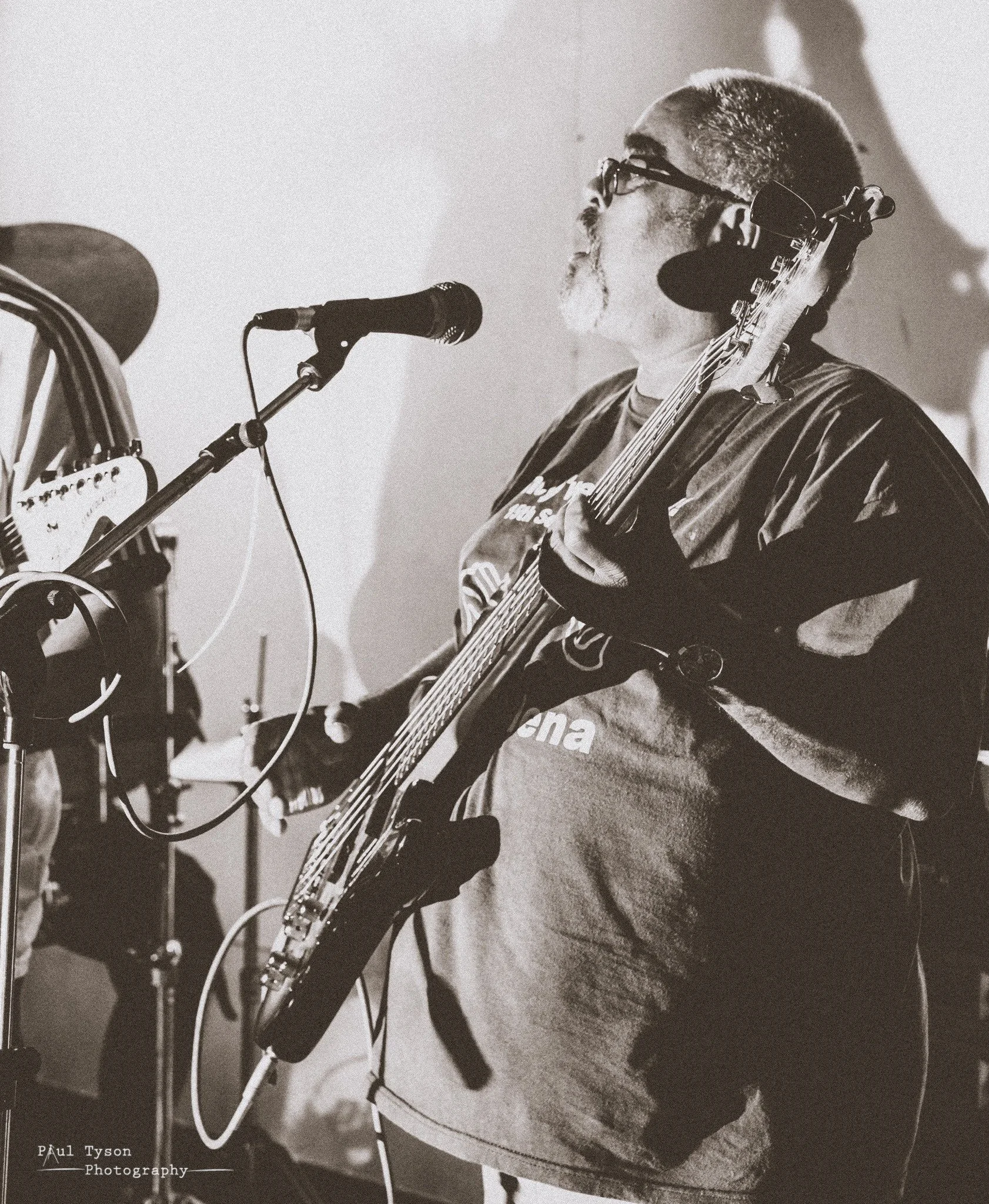
Johnny Dillon. Photo by Paul Tyson
Learning “by ear”.
Far more Saints play music than read it. Every musician I spoke to mentioned that Saints generally learn “by ear” rather than “by music” (from notation). Stewie mentions that he originally learned just by watching others play, and adapting it to his biscuit-tin drum set. Saints tend to have quite honed aural skills and memory for this reason.
In his 1984 booklet Music on Saint Helena, Eric George MBE says there were likely around ten Saints who could read music, four of whom understood it well enough to write four part harmony.
Constraints lead to creativity
The lack of formal training for leads to musical creativity. By adapting songs and music they may have heard into their own contexts, the music takes its own form. Vincent explains this beautifully and relates it to a friend of his - Stedson Stroud. Stedson’s unique singing and songwriting style, Vincent explains, emerges from technical constraints. Saint Helenian musical identity, it seems, is built through experimentation and adaptation,
Stedson has an interesting collection of instruments he uses to make his music, including an ankle tambourine and a Yamaha drum machine. As he once explained to me, he found it challenging to stay in time, which he remedied with the addition of his drum machine. In that way, he has approached physical and technical limitations with creative, resourceful solutions. You may catch places where meter gets mixed or interrupted, due to his instinctive approach.
This creativity emerging from constraint can also be seen in the performance by the 2S band, where the whole rhythm section is provided by an arranger keyboard. Arranger keyboards, specifically the Yamaha Tyros series, are popular choices on Saint Helena, as they allow one musician to put on a fully developed performance. Of course, this leads to limitations in what can be played. Seabird, as he is known, has great command of the controls, and has mapped the pitch-bend function to a foot-switch because his finger-wheel broke a long time ago.
Stedson Stroud, 2024
Saints’ DIY culture has adapted to new tools, rather than disappearing.
One might expect that with modern internet connectivity, unlimited information, and easier access to equipment, this DIY spirit would begin to disappear. Instead, it seems to have simply evolved. Zac describes teaching himself music production through digital tools and instinctively experimenting until he could recreate the sounds he admired. Now, with the internet, Zac was able learn from YouTube, but without anyone else to bounce his ideas off of and develop with, experimentation is still at the core of his development.
Mark hopes that his AI-music might encourage others to realise that they can create music - or anything - themselves, even without formal training or technical knowledge. Mark remarks that the AI tools at his disposal helped him overcome constraints of time when it comes to writing his original music. Both musicians have adopted modern tools, and used experimentation despite constraints to achieve a creative product. This is all driven by a sense of “I can do this myself”, which has always been present in Saint Music.
A home-made gig
In March 2026, I was involved in a gig that perfectly reflected this Saint Helenian DIY culture. The idea was to put on a real outdoor festival-style performance for somebody’s birthday. A small group of us loosely coordinated the setup: I was responsible for the sound system — itself a mash-up of different people’s PA equipment — while others worked on the stage. I wasn’t entirely sure what to expect, but when I arrived, the stage setup was far better than I could have imagined. For the sake of a community gathering, a few people had pooled their ideas, equipment, and efforts to create something genuinely impressive out of what was available.
What struck me most about the experience was that it did not feel unusual. The same improvisational attitude of decades earlier described by Vincent and Tony still seemed completely intact. The tools may have changed but the instinct to create with whatever is available remains deeply embedded within Saint Helenian musical culture.
You have reached the end of Part 2: Musical Macgyvers